

Soar on Midlife’s Perfect Storm To Master Leadership and Life
Midlife Has Been My Favorite Period of Life — a Dynamic, Challenging, and Invigorating Age
My 40s and 50s were an incredible journey. Broadly defined as the period between the late 30s to the late 60s, midlife isn't just about growing older; it's a time for becoming bolder, gaining wisdom, and deepening connections with the core of who we are.
During my time coaching leaders in this stage, I've observed consistent patterns. These experiences have led me to understand midlife not as a time of decline but as a pivotal moment for radical leadership development.
The Three Winds of Change in Midlife Leadership
Midlife presents a unique nexus of "Three Winds of Change" — physiological, neurological, and parental — that profoundly impact your leadership style. This period offers a chance to reevaluate your life, shed long-held practices, and embrace a new leadership style suited to the second half of your career.
Physiological Wind: Energy changes. Stamina varies. Recovery takes more time. What once ran on intensity begins to run on presence, a transition that deepens steadiness and discernment at senior levels. This shift often changes how decisions are made, from fast-paced drive to steadier judgment.
Neurological Wind: Processing becomes less linear, memory less instant. Yet synthesis deepens, paradox becomes more tolerable, empathy widens, insight accelerates. This is the stage where leaders stop solving problems sequentially and begin sensing the whole system at once.
Parental/Relational Wind: Children step into their own lives; parents need more care. Leaders find themselves between holding on and letting go — a tension that softens ego and widens perspective. Collaboration and enterprise thinking often emerge from this broader relational horizon.
The Midlife Leadership Crucible
Midlife presents a choice: cling to past leadership styles or embrace the winds of change. It's an opportunity to harness the depth of experience that comes with physical maturity, tap into cognitive insights, and adopt an empowering style that reflects our evolution.
Leaders in midlife are uniquely positioned to bring a balanced perspective to their organizations, blending seasoned wisdom with a renewed approach to challenges and opportunities. This period is marked by an increased adaptability, deeper empathy, and a visionary approach that balances immediate needs with long-term aspirations.
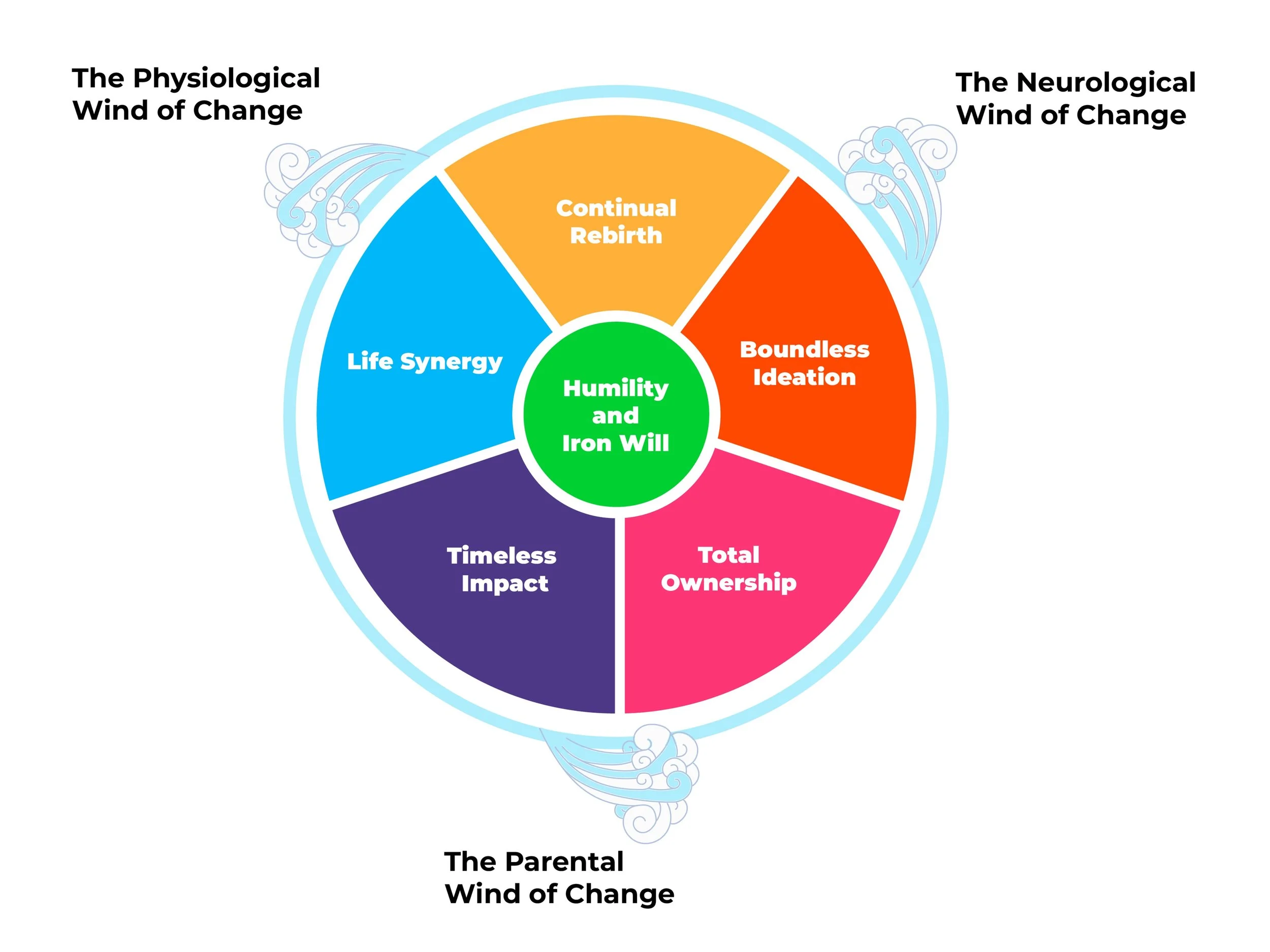
Six Leadership Traits of Midlife Mastery
The interplay of physiological, neurological, and parental shifts at midlife – the Three Winds of Change – acts as a powerful catalyst for the development of six key leadership traits.
Humility and Iron Will: Midlife loosens the ego structures that held the center in earlier decades. What emerges is a quieter strength — grounded, unforced, and anchored in experience rather than assertion. It’s the blend of deep humility and unwavering resolve that makes senior leaders both steady and courageous.
Continual Rebirth: After decades of chapters opening and closing, leaders begin to trust their own ability to reinvent. Midlife brings the capacity to release what no longer fits and step into new forms without drama or urgency. Change stops being a disruption; it becomes a natural rhythm.
Boundless Ideation: As synthesis deepens and linear thinking eases, ideas come faster — often surprisingly so. Midlife broadens perceptual bandwidth, allowing leaders to see patterns, possibilities, and solutions others miss. Creativity feels less like effort and more like flow.
Total Ownership: With fewer illusions about control, leaders take responsibility differently: fully, willingly, without defensiveness. They see the system, their part in it, and what their role demands — not from pressure, but from maturity. This ownership has weight without heaviness.
Timeless Impact: As horizons widen and the future shortens, leaders think in longer arcs. Meaning, legacy, and contribution start to carry more gravitational pull than performance or achievement. What emerges is a commitment to shaping something that lasts.
Life Synergy: The boundaries between work, self, family, and purpose soften. Leaders begin to act from a more integrated center, where decisions feel both professionally sound and personally true. Presence becomes the organizing principle — and it shows.