


How reliably does your C-suite lead together?
Even when it costs them?
The Emergence Indicator reveals the collective capacities your executive team can rely upon and how they translate into readiness for situations that place unusual demands on enterprise leadership.
What’s included:
15-minute online assessment for each C-suite member and their direct reports, examining 20 indicators across five domains
Executive report revealing collective strengths, perception gaps, and readiness for five high-stakes situations:
Crisis response
Strategic reinvention
Executive turnover
Board, regulatory, or public scrutiny
Enterprise expansion or M&A
Facilitated C-suite conversation to explore the findings together
USD 10,000
Per executive-team assessment, including report and facilitated C-suite conversation.
Most team assessments start with what’s missing. We start with what life may already have built.
The Emergence Indicator is designed through a Second Adulthood (45–65) lens.
Decades of life can build the capacity to commit before clarity, stay with what can’t be quickly resolved, and take responsibility without controlling the outcome.
The assessment examines how reliably those capacities show up across the C-suite — even when exercising them comes at a personal cost, challenges established authority, or requires letting go of what once worked.
It also asks whether their direct reports experience them in the same way.
-
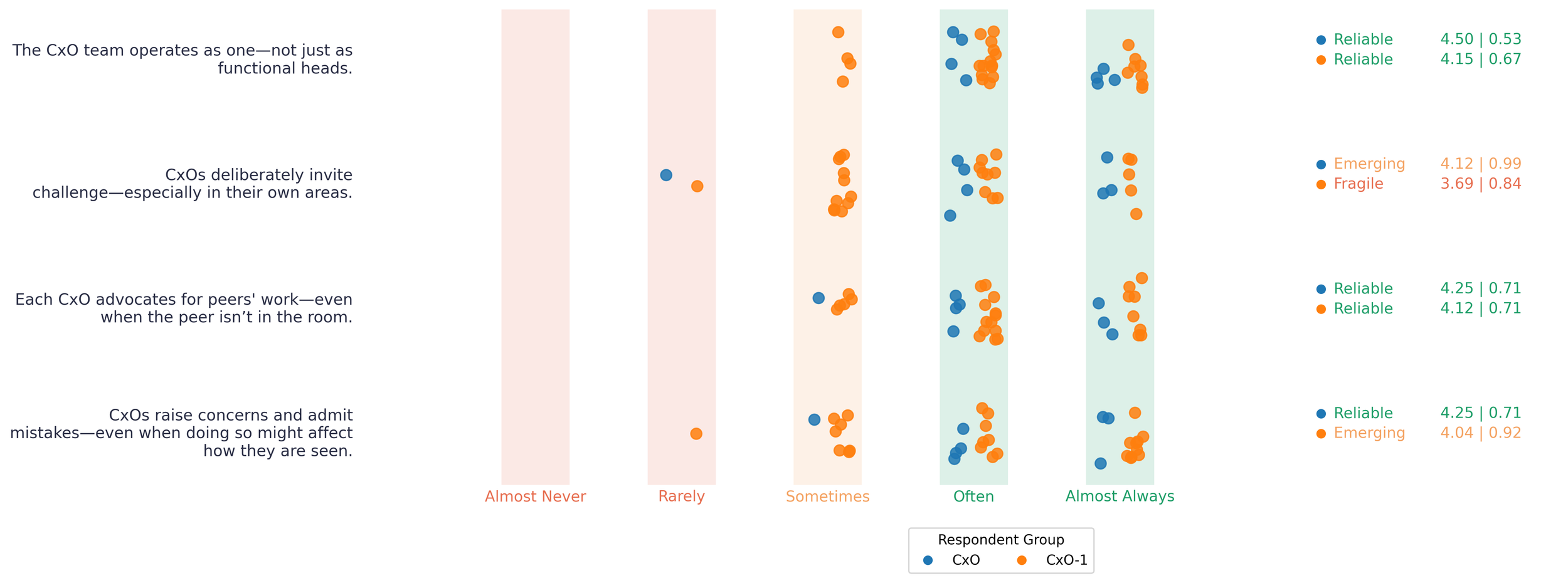
Here, the C-suite sees itself inviting challenge more than their direct reports do: Emerging from inside, Fragile from outside.
What would this reveal about your team?
The Emergence Indicator examines 20 indicators across five domains of mature enterprise leadership.
Collective Leadership — What holds the team together when things come undone?
Enterprise Ownership — When priorities collide, what does the team protect?
Unfiltered Conversations — Does the team hear every voice when it matters most?
Decisive Execution — How reliably does the team turn decisions into collective action?
Adaptive Capacity — How readily can the team question what works and change course?
How consistently does the capacity show up?
The Emergence Indicator asks whether the capacities required for collective enterprise leadership show up often enough, and consistently enough, to be depended upon.
Reliable — The capacity is experienced frequently and with enough consistency to be considered dependable.
Emerging — The capacity is experienced frequently overall, but not yet consistently enough across respondents to be considered dependable.
Fragile — The capacity is not yet experienced frequently enough to be considered dependable.
A capacity can be Reliable for the C-suite and Fragile for those reporting to them—or the other way around. The differences are often as revealing as the classification itself.
What becomes visible when we connect the dots?
The report connects capacities across the data to identify five recurring system patterns and indicates the level of concern each currently warrants.
Divisional Diplomacy — Peer relationships remain more polished than candid, challenging, and mutually invested.
Withheld Wisdom — Relevant enterprise judgment does not consistently enter the collective when the issue lies beyond someone’s formal domain or position.
Ownership Blindspot — Ownership is clear within functions but becomes less dependable when responsibility crosses functional boundaries or no single owner is obvious.
Organizational Haze — Strong functional activity produces greater clarity within individual domains than across the enterprise, making cross-boundary patterns and weak signals harder to see and act upon collectively.
Legacy Gravity — Established successes, commitments, and assumptions exert more pull than the need to question, release, or redirect them.
If it hit tomorrow… how ready is the team?
The team's current collective capacities are translated into readiness signals for five situations that place unusual demands on enterprise leadership:
Crisis Response — when risk spikes and time compresses.
Strategic Reinvention — when the team must redefine its value or identity.
Executive Turnover — when a CEO or C-suite leader departs or arrives.
Board, Regulatory, or Public Scrutiny — when external challenge intensifies.
Enterprise Expansion or M&A — when growth crosses functional boundaries.
What happens after you start?
-

Complete the assessment
Your CxOs and their direct reports respond to the same 20 questions across five domains.
Approximately 15 minutes.
-

Receive the report
You receive a clear picture of:
where collective enterprise leadership is Reliable, Emerging, or Fragile
where the C-suite's experience of itself aligns—or does not align—with the experience around it
which system patterns become visible when the capacities are considered together
where emerging alignment is already forming
how the team's current capacities translate into readiness signals for five high-stakes scenarios
what the team may already be teaching the wider organization through the way it leads together
-

Explore the findings together
The report becomes the starting point for a facilitated C-suite conversation about what the team can now see together—and what becomes possible once it is visible.