


A C-suite can be trusting, candid, and committed, yet still retreat to functional ownership under pressure.
The question is not simply whether your executive leaders work well together.
Are they actually leading the enterprise together—and do the leaders around them experience the same team they believe themselves to be?
Most team assessments start with what’s missing. We start with what life may already have built.
The Emergence Indicator is designed through a Second Adulthood (45–65) lens. It looks at how reliably capacities forged through decades of life are available across the C-suite — and whether the leaders around them experience those capacities too.
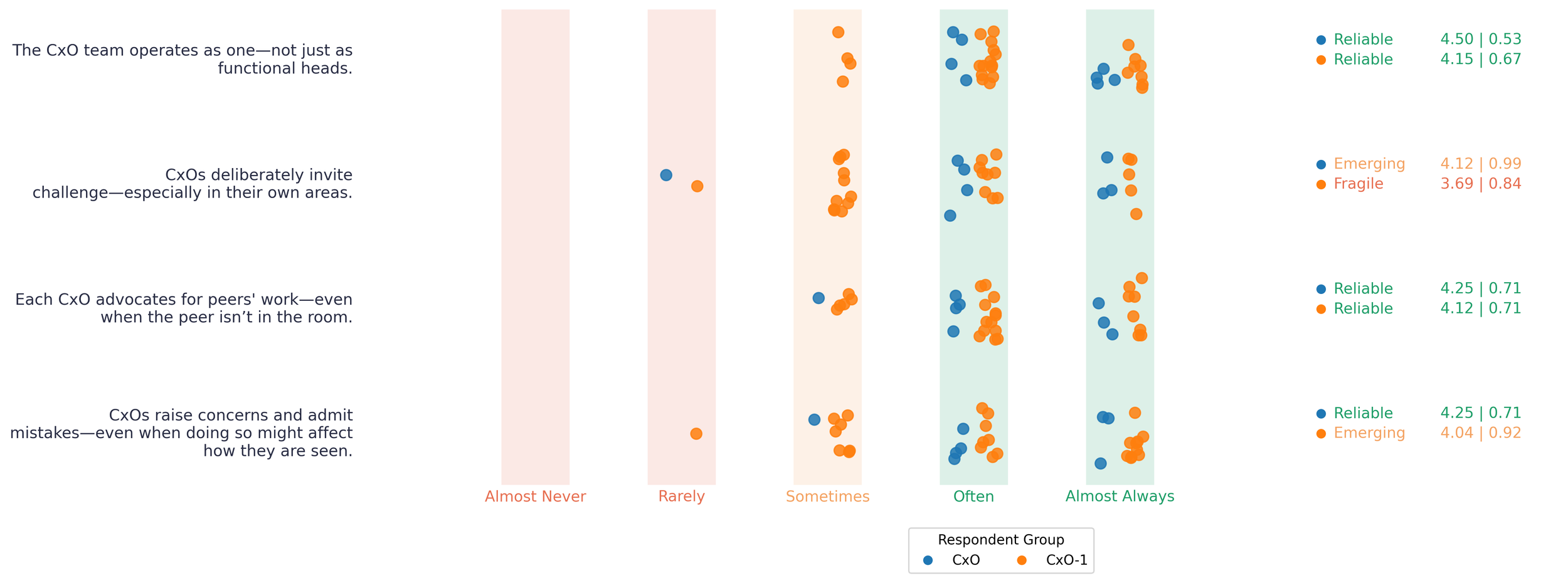
Here, the C-suite sees itself inviting challenge more than the leaders around them do: Emerging from inside, Fragile from outside.
What would this reveal about your team?
The Emergence Indicator examines 20 indicators across five domains of mature enterprise leadership.
Collective Leadership — What holds the team together when things come undone?
Enterprise Ownership — When priorities collide, what does the team protect?
Unfiltered Conversations — Do we hear each other when it matters most?
Decisive Execution — How clearly does our resolve show up when it matters most?
Adaptive Capacity — How fully are we leveraging our collective capacity for renewal?
How consistently does the capacity show up?
The Emergence Indicator asks whether the capacities required for collective enterprise leadership show up often enough, and consistently enough, to be depended upon.
Reliable — The capacity is experienced frequently and with enough consistency to be considered dependable.
Emerging — The capacity is experienced frequently overall, but not yet consistently enough across respondents to be considered dependable.
Fragile — The capacity is not yet experienced frequently enough to be considered dependable.
A capacity can be Reliable for the C-suite and Fragile for the leaders around them—or the other way around. Those differences are often as revealing as the classification itself.
What becomes visible when we connect the dots?
The report connects capacities across the data to identify five recurring System Patterns and indicates the level of concern each currently warrants.
Divisional Diplomacy — Peer relationships remain more polished than candid, challenging, and mutually invested.
Withheld Wisdom — Relevant enterprise judgment does not consistently enter the collective when the issue lies beyond someone’s formal domain or position.
Ownership Blindspot — Ownership is clear within functions but becomes less dependable when responsibility crosses functional boundaries or no single owner is obvious.
Organizational Haze — Strong functional activity produces greater clarity within individual domains than across the enterprise, making cross-boundary patterns and weak signals harder to see and act upon collectively.
Legacy Gravity — Established successes, commitments, and assumptions exert more pull than the need to question, release, or redirect them.
If it hit tomorrow… are we ready?
The team's current collective capacities are translated into readiness signals for five situations that place unusual demands on enterprise leadership:
Crisis Response — when risk spikes and time compresses.
Strategic Reinvention — when the team must redefine its value or identity.
Executive Turnover — when a CEO or C-suite leader departs or arrives.
Board, Regulatory, or Public Scrutiny — when external challenge intensifies.
Enterprise Expansion or M&A — when growth crosses functional boundaries.
What happens after you start?
-

Complete the assessment
Your CxOs and selected leaders who work closely with them respond to the same 20 questions across five domains.
Approximately 15 minutes.
-

Receive the report
You receive a clear picture of:
where collective enterprise leadership is Reliable, Emerging, or Fragile
where the C-suite's experience of itself aligns—or does not align—with the experience around it
which System Patterns become visible when the capacities are considered together
where Emerging Alignment is already forming
how the team's current capacities translate into readiness signals for five high-stakes scenarios
what the team may already be teaching the wider organization through the way it leads together
-

Debrief the findings live
The report becomes the starting point for a facilitated C-suite conversation about what the team can now see together—and what becomes possible once it is visible.